
Are guinea pigs nocturnal? The short answer to “are guinea pigs nocturnal” is no: a pet guinea pig may browse hay at midnight, nap in the afternoon and become lively near sunrise without having a fixed nighttime lifestyle. The better description is a flexible pattern of repeated rest and activity, with crepuscular tendencies.
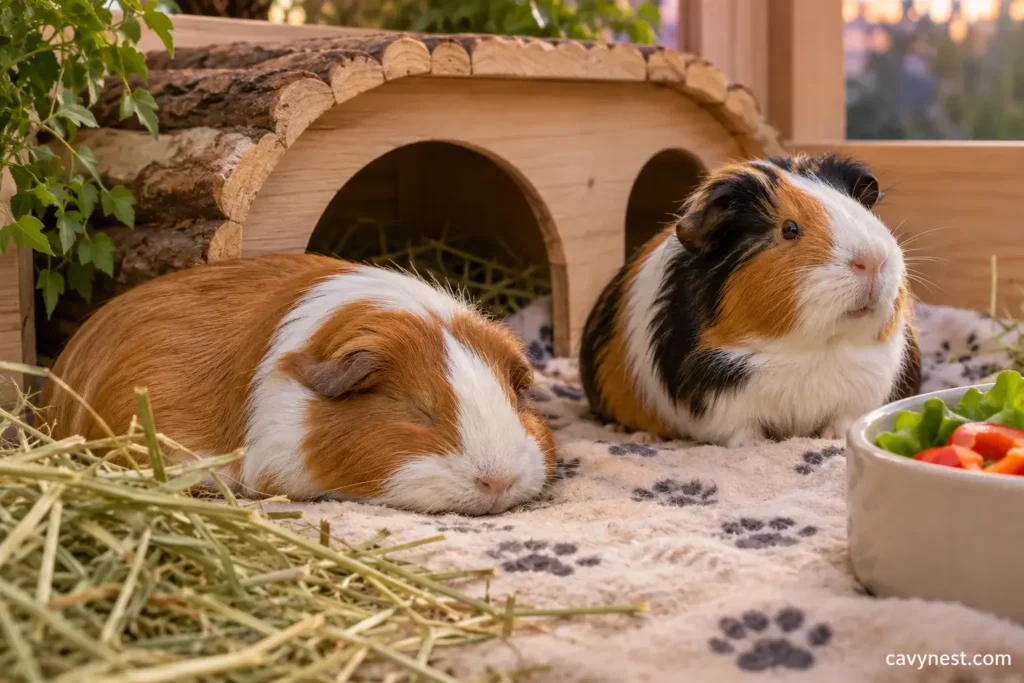
Quick answer / Kurzantwort / Respuesta breve / Réponse rapide: No. Guinea pigs are not strictly nocturnal: they rest and move in many short bouts throughout the day and night, often showing activity around dawn and dusk. An individual may adapt to household routines. A guinea pig awake after dark is not automatically sleep deprived; look instead at appetite, droppings, alertness and changes from its normal pattern.
Practical takeaway: Plan for a calm nighttime room, accessible hay and water at all hours, and several covered resting areas. Do not force a human sleep schedule on a guinea pig.
Are guinea pigs nocturnal, diurnal or crepuscular?
The short answer to “are guinea pigs nocturnal” is no: a pet guinea pig may browse hay at midnight, nap in the afternoon and become lively near sunrise without having a fixed nighttime lifestyle. The better description is a flexible pattern of repeated rest and activity, with crepuscular tendencies.
The Merck Veterinary Manual describes greater activity at dawn and dusk, while RSPCA guidance explains how shelter and predator avoidance shape cavy behavior. These are useful tendencies, not a promise that every pet will follow the same clock. (Merck Veterinary Manual; RSPCA).
Why guinea pigs rest in short bursts
Guinea pigs need to eat roughage regularly and remain responsive to their surroundings. Their day therefore includes repeated quiet intervals interspersed with eating, walking, social contact and grooming rather than one uninterrupted human-style night of sleep.
Research on individual activity rhythms supports caution about rigid schedules: a telemetry study by Akita and colleagues found clear daily rhythms in some guinea pigs but not all. It does not establish a universal number of sleep hours for pets. (Akita et al., 2001).
What normal guinea pig sleep looks like
A resting guinea pig may sit tucked into a hide, crouch low, stretch out or stay unusually still for a brief period. Relaxed posture and a quick return to normal eating can be reassuring, but neither an open eye nor a closed eye alone proves sleep.
Avoid waking an animal repeatedly to test whether it is asleep. Check from a respectful distance and learn that particular guinea pig’s usual body language; sudden changes matter more than an isolated pose.
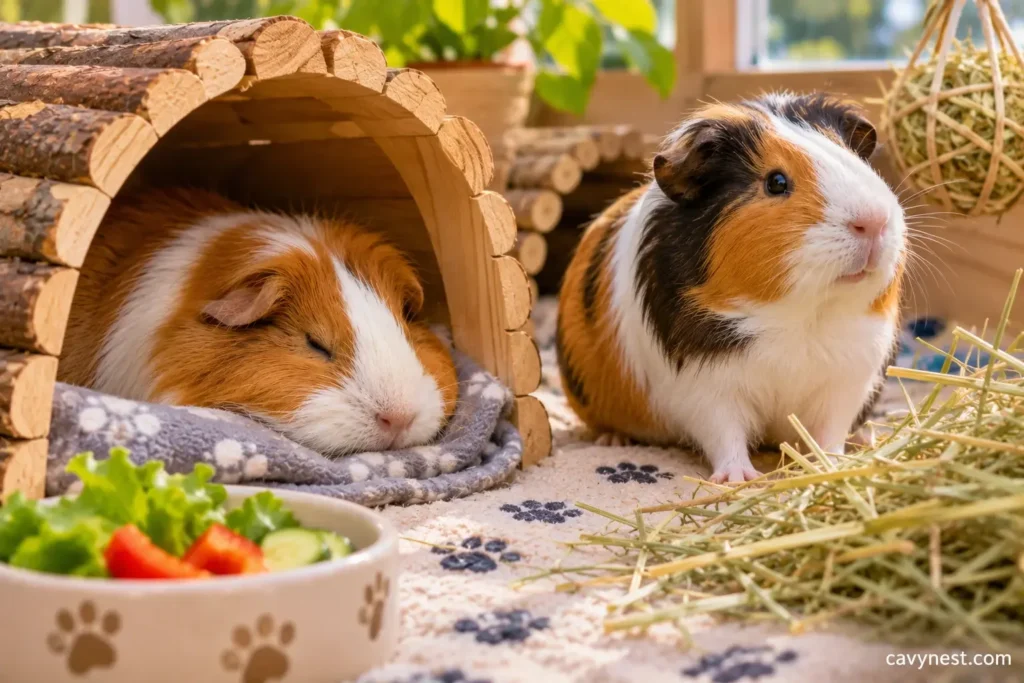
Daytime versus nighttime: a practical comparison
Both daytime and nighttime can contain feeding, exploration and resting. More activity near dawn or dusk is compatible with typical behavior, while individual companions may differ even in the same enclosure.
Use the comparison below as an observation aid, never as a diagnostic test or a strict timetable. Record what you actually see across several ordinary days.
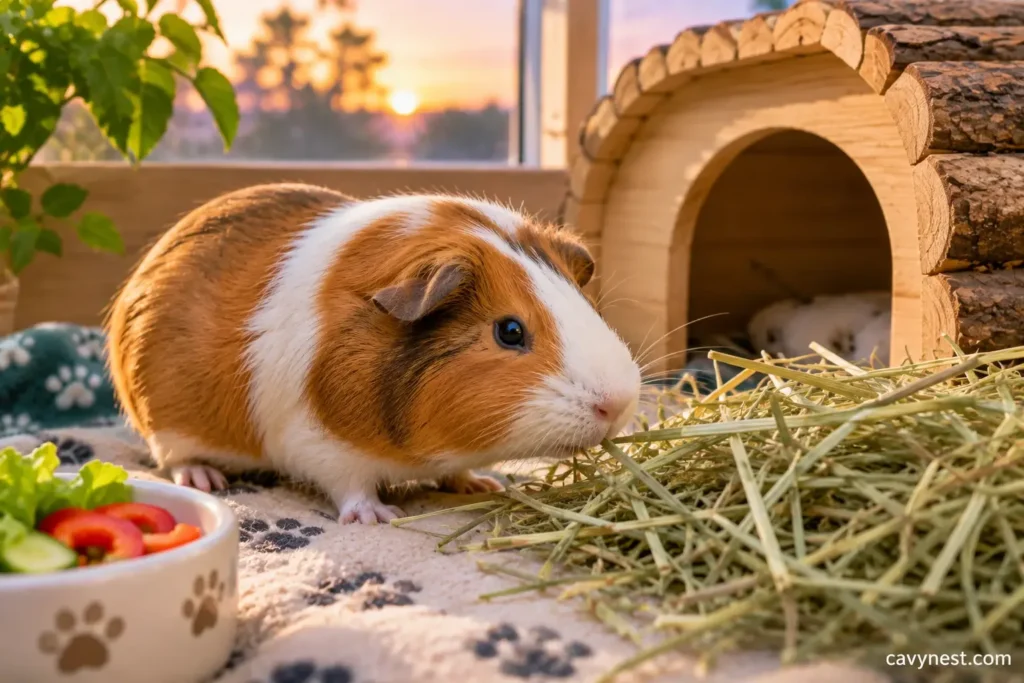
Typical observations across a 24-hour period
| Time of day | What you may notice | How to interpret it |
|---|---|---|
| Early morning | Often active; feeding and exploring | Normal tendency, not a rule |
| Midday | Rest, feeding and brief movement | Resting does not prove deep sleep |
| Dusk | Often another active period | Enrichment may be welcome |
| Overnight | Rest mixed with hay eating and movement | Keep food and water available |
How to make a sleep-friendly enclosure
Place the enclosure in a stable, ventilated space away from direct sun, draughts, loud speakers and abrupt nighttime light. Give each guinea pig more than one hiding place, comfortable dry bedding, and enough room to move away from its companion when it wants quiet.
Hay and fresh water should remain available overnight. Good flooring, a suitable cage footprint and routine spot cleaning can matter more to rest quality than trying to impose a lights-out hour.
appropriate guinea pig cage size · choosing safe bedding
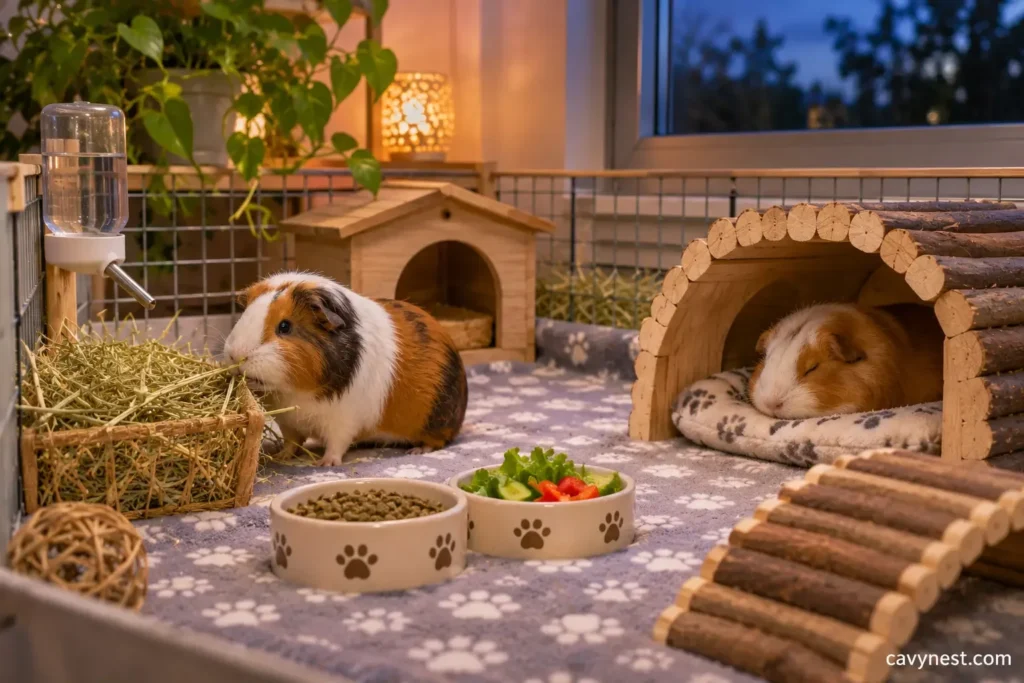
What to do when your guinea pig makes noise at night
Rustling hay, drinking, short squeaks and footsteps can happen after dark. First check that food and water are available and that the housing is safe; do not assume nighttime movement means distress.
If sound is a household problem, move the enclosure to a suitable calm room and avoid noisy accessories. Do not cover the enclosure with an airtight blanket, withhold food or isolate a social animal as a way to make it silent.
When increased sleeping signals a health problem
A guinea pig that is much quieter than usual, refuses food, passes fewer droppings, has difficulty breathing, seems painful or cannot be roused normally needs prompt veterinary advice. Loss of appetite or absent droppings calls for urgent care, not observation until morning.
The PDSA identifies low energy and changes in normal behavior as possible illness signs; UC Davis emergency guidance highlights not eating, abnormal stools and breathing difficulty. A resting pose alone cannot distinguish normal sleep from sickness. (PDSA; UC Davis CVET).
A change in eating or droppings matters more than the number of minutes spent lying down.

finding a guinea pig veterinarian
Common myths and mistakes
A common mistake is calling guinea pigs strictly nocturnal just because they eat at night. Another is interpreting any closed-eye rest as sickness, or any stillness as harmless sleep. Context is essential.
Avoid universal sleep-hour claims, bright lights left on all night, repeated handling of a resting animal, and forced daytime play when it has chosen to retreat. Never use a sleep schedule as a replacement for monitoring appetite and feces.
Final verdict: respect their natural rhythm
Healthy guinea pigs can be active and resting across a full 24-hour period. Provide predictable care without demanding that they match your bedtime, and compare behavior with each animal’s own established routine.
When activity changes together with reduced eating, fewer droppings or other symptoms, contact a guinea-pig-experienced veterinarian quickly. Understanding the pattern is useful; observing welfare is essential.
Frequently asked questions
Do guinea pigs sleep at night?
Yes. Guinea pigs rest at night as well as during the day, usually in shorter bouts rather than one uninterrupted period.
Are guinea pigs more active at dawn?
Often, yes. Dawn and dusk are common activity peaks, although individual schedules vary.
How many hours do guinea pigs sleep?
There is no single reliably applicable total for every pet guinea pig; observed rest varies by individual and environment, and fixed online estimates should not be treated as a diagnosis.
Can guinea pigs sleep with their eyes open?
They may appear to rest with eyes open or partly open, but eye position alone does not reliably confirm whether they are asleep.
Why is my guinea pig eating at midnight?
Eating during the night can be normal because guinea pigs feed repeatedly through the 24-hour cycle and need continuous access to hay.
Should I turn off the lights for my guinea pig?
Provide a predictable natural day–night cycle and a dark, quiet resting option instead of keeping bright lights on overnight.
Is it normal for my guinea pig to hide and sleep all day?
Some hiding and resting is normal, but a substantial new increase in hiding, low energy or reduced eating deserves veterinary assessment.
Should I wake my guinea pig to play?
No. Let a resting guinea pig wake naturally whenever possible, then offer gentle interaction during an alert period.
When is nighttime inactivity an emergency?
Seek urgent veterinary care if inactivity accompanies refusal to eat, absent or markedly reduced droppings, breathing trouble, collapse or difficulty responding.